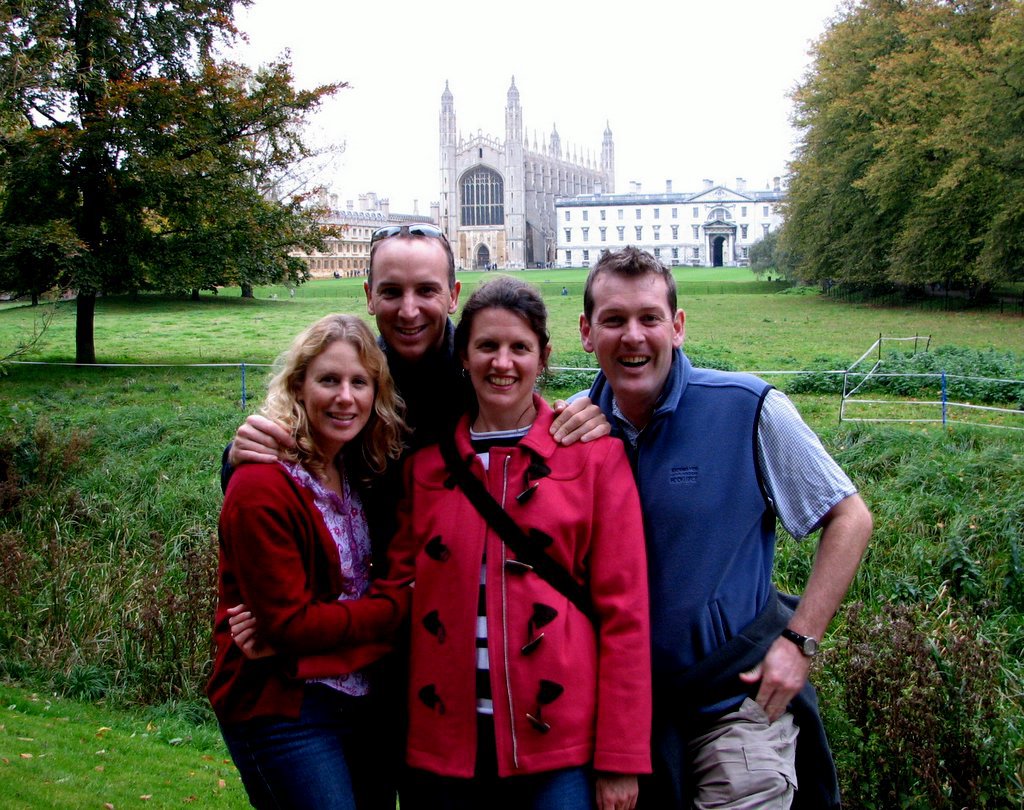
Memories don't come better than punting along the Cam with Ally, work mates and mum and Mike when they visited us.
Memories don't come better than punting along the Cam with Ally, work mates and mum and Mike when they visited us.
In 2005, I traveled to Dahab in Egypt to complete a scuba diving course in the Red Sea. It was an extraordinary environment, but the true highlight arrived on the second day of our training when our group descended to a depth of twenty metres.
The coral reef was absolutely spectacular—a true wonderland of vibrant color and marine life. As we glided through the water, I was overcome by a profound sense of wonder and peace. I felt entirely present, experiencing a transcendent, spiritual moment of feeling completely at one with everything around me.
When I practice meditation at home, I often use a soft, humming "om" to anchor myself firmly in the present moment. Wrapped in the silence of the deep sea and filled with a sudden desire to express that connection, I let out a gentle, low "om" into my regulator as we swam alongside the reef.
After thirty minutes of exploring, our group finally ascended and exited the water. The moment we pulled off our masks, one of the girls from our group turned to the rest of us with wide, amazed eyes.
"My God," she gasped, "did you hear the coral humming?! I've never heard anything like it in my life!!"
I froze, caught in a wave of sudden embarrassment, and decided it was best to say absolutely nothing. To this very day, she is likely out there somewhere in the world, completely convinced that the coral reefs of the Red Sea sing a beautiful, spiritual song to those who dive deep enough to listen.
I love tennis and have played on and off my entire adult life. If I have a "claim to fame" on the court, it’s the staggering, almost comical difference in speed between my first and second serves. My first serve was always incredibly hard—a raw, high-velocity strike. My second serve, by contrast, was a gentle "putt" over the net, the kind of shot you’d expect from a 90-year-old grandmother on a Zimmer frame.
During my time in the UK, I attended a professional tennis coaching camp. They used a speed-tracking machine to monitor our serves and provide data-driven advice. When it was my turn to step up to the line, I unleashed my first serve with everything I had.
The coaches were stunned. They checked the monitor and told me, with no small amount of awe, that it was the hardest serve they had measured in five years. I stood there, glowing with pride, basking in the glory of being the camp’s unofficial speed king.
Then came the "but."
"Graeme," they continued, looking at the rest of the data, "your percentage of serves actually landing in the court is the lowest we have ever recorded. Our professional advice to you is to stop using that serve entirely. Just use the granny serve."
I had achieved the pinnacle of power, only to be told that my record-breaking thunderbolt was statistically less useful than a Zimmer-frame lob. It was a humbling lesson in the difference between "impressive" and "effective"—and a reminder that in tennis, as in life, it doesn't matter how fast you're going if you aren't actually on the map.
When I lived in London, I took up rollerblading, and it was pure, unadulterated exhilaration. Every weekend, I would skate from Hammersmith through the city streets to Hyde Park for a game of touch rugby. Gliding over the smooth tarmac, weaving through the urban landscape, I felt a sense of total freedom—a modern-day centaur on wheels.
Then, I moved to Cambridge.
I arrived with the same skates and the same excitement, eager to explore the historic city on eight wheels. However, I quickly discovered a fundamental design flaw in my plan: Cambridge was built in the 14th century, and its architects had absolutely no foresight regarding polyurethane wheels.
The city is a labyrinth of ancient, beautiful, and utterly merciless cobblestones.
Rollerblades, as it turns out, do not come equipped with shock absorbers. The moment I hit those historic stones, the "exhilarating freedom" was replaced by a bone-shaking, teeth-rattling vibration that threatened to liquify my internal organs. It wasn't a glide; it was a full-body seismic event. Every joint in my body felt the protest of six hundred years of masonry.
My dreams of skating through the university grounds were quickly curtailed. I was forced to abandon the historic center and confine my skating to a small, humble patch of modern tarmac near my house. It was a stark lesson in historical compatibility: you can’t bring 21st-century momentum to a 14th-century surface without paying for it in every bone of your body.
They say airline travel is hours of boredom interrupted by moments of stark terror. In 2004, while working for Volvo, I learned exactly how "stark" that terror could be. I was on a Ryanair flight from Stansted to Gothenburg—the kind of extreme low-cost experience where you half-expect to be charged for the air you breathe.
Suddenly, the air decided to leave us.
The plane didn't just dip; it plummeted. We fell a staggering 1,000 metres in a matter of seconds. There was a violent, bone-shaking thump that sent luggage cascading out of the overhead lockers like plastic hail. Then, the nightmare trifecta: smoke began to coil through the cabin, the oxygen masks dropped from the ceiling with a synchronized snap, and the screaming started.
Even the flight attendants, usually the stoic guardians of "tea or coffee," were white-faced with genuine panic. The man sitting next to me broke down completely. He whipped out a photograph of his wife and twin girls, staring at it with the haunted intensity of a man saying his final goodbye.
And me?
I have no idea why. Perhaps it’s some prehistoric, hard-wired glitch in the Myburgh DNA. Amidst the smoke, the screams, and the falling luggage, I got the giggles.
I tried to suppress it, knowing that a full-blown guffaw would be the height of social impropriety while my neighbor was mourning his own life, but I couldn't stop. I sat there, strapped into my seat, giggling uncontrollably into my yellow oxygen mask. It was as if my brain had decided that if we were going down, we might as well go down finding the whole thing ridiculous.
Eventually, the plane stabilized. The smoke cleared, the screaming subsided, and we landed without a word of explanation from the captain. That’s low-cost travel for you: you pay for the seat, but the life-altering trauma is complimentary.
For weeks afterward, I walked around in a state of pure, shimmering euphoria. I had stared into the abyss through a plastic mask while laughing like a maniac, and coming out the other side made the world seem impossibly bright. It turns out that a near-death experience is the ultimate "reset" button—even if your specific reaction to it is enough to make a grieving father think he's seated next to a psychopath.
While driving home with Ally when we lived in Cambridge, she held out a bottle and said with genuine enthusiasm, "Mmmm. Try this!"
I was focused on the road, thirsty, and caught the words "Sugar Vanilla Nectarine" in my peripheral vision. Naturally, I took a greedy, unsuspecting gulp.
"No! No!" Ally shrieked. "I meant smell it!"
"Too late," I replied, though the words were somewhat muffled by the thick, Mediterranean-scented bath bubbles beginning to foam from my mouth.
It was not a pleasant culinary experience. My breath has never been more "calming," but I am seriously considering suing Boots for deceptive packaging.
I didn't get the refreshing snack I was promised, but on the bright side, every time I hiccuped for the next three hours, I blew a perfectly formed, vanilla-scented bubble.